Questions to ask BEFORE you write your Press Release:
- What message am I trying to get into the media and to my target audience?
- Is my news or message interesting, new and relevant?
- Is the journalist, producer or reporter going to be excited enough or interested enough to open my email?
- When did I last send a press release out? Don't worry if this is your first time.

We don't recommend sending more than one per week as we don't want to annoy the journalist and make them think of your brand negatively if you spam or send too many emails to them.
Write with your audience and industry in mind.
Before you write your press release, know what industry or industries you are targeting.
If you are writing a press release focusing on business then your release must focus on your business and must be tailored to a business audience.
If you are writing a press release that is more fun, quirky, has fun facts, tips or research focusing on consumer and lifestyle industries, then make sure you are writing to that audience.
Think of your customer and then think of what media they would read. If your customer is B2B in business then you would need to focus on a business industry. If your customer is purchasing skincare products then you would need to target the beauty industry however you can also target lifestyle, retail, pharmacy etc. See all the industries we distribute to.
Write in Third Person, Not First Person
When you use "third person" in writing or speaking, it's like being a narrator in a story who talks about other people, not about themselves. Imagine you're telling a story about your friends, but you're not part of the action. You would say things like "He walked to the store" or "She painted a picture." You're not saying "I walked" or "We painted" because you're not talking about what you did, but what others did. It's like being an observer, watching the story happen and then telling someone else about it.
Your Press Release must be written in third person.
A Bird's Eye View of the Press Release
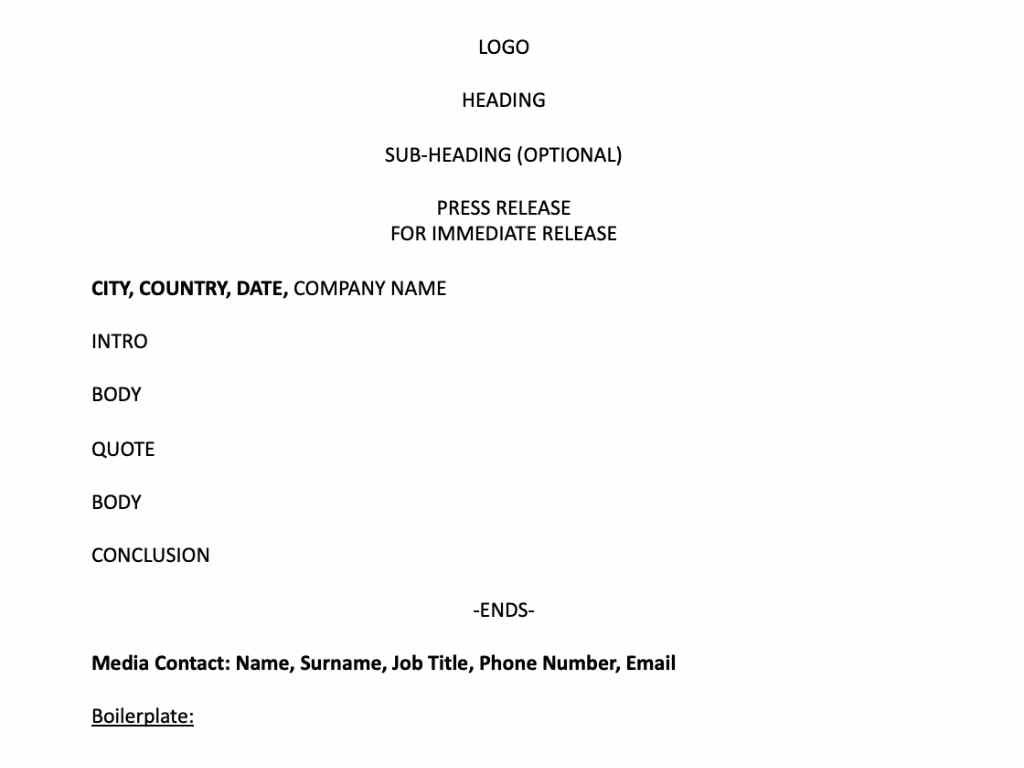
Below is an example of a bird's eye view of a Press Release Template. We will now go into each section in detail to help guide you to write your own professional press release. We are a team of experienced PR consultants so we have put together our step by step guide so that you can put together a professional, well-formatted press release to get the best value and results for your business. You can also watch our how to video. PR and Press Release writing is not rocket science. You can easily follow our steps and put together a professional press release.
Let's begin...
LOGO: The first step is to open a word document (offline or Google Docs) and insert your logo at the top of the page.
Use a high resolution logo and insert it into the middle of the page by centering it. This is what we prefer but you can also decide to place your logo on either end of the page.
We want your press release to look as professional as possible to get you the best media coverage and results.
How to write a killer heading
Heading: Summarise your press release in one exciting line
- Keep it Short and Sweet: Your headline should get straight to the point. Make it snappy and easy to understand.
- Use Exciting Words: Choose words that make your headline pop and sound interesting. Think about words that you'd want to click on.
- Show What's Cool About Your News: Make sure your headline shows why your announcement is awesome or important. Is it about a new event, a big win, or an innovative service?
- Talk to Your Audience: Think about who you're writing for and use words they would like. Avoid jargon or technical words.
- Make it Sound Urgent: If your news is about something happening soon or something really timely, make that clear in your headline.
- Keep it Simple: Don't use complicated words or phrases that might confuse people. Keep it straightforward.
- Add Numbers If You Can: If you've got interesting numbers or stats, put them in your headline.
- Try Out a Few Options: Write a couple of different headlines and see which one sounds the best. You can use your second best one for your sub-heading (optional).
Remember, the headline is like a first impression: you want to make it good so people will want to read more about what you have to say!
Subheading: A subheading is optional. If you have two great headings put one in the heading and one in the subheading.
Don't write your heading or subheading in all capitals.
The next step is to decide if you want the press release to go out immediately or at a specific date known as an embargo (not recommended, see below).
Example below:
LOGO
HEADING
SUBHEADING (OPTIONAL)
Press Release
For Immediate Release
OR EMBARGO DATE (EMBARGO 7th JANUARY 2024)
We don't recommend using an embargo unless you absolutely have to use one. We find that unless you are a massive brand, embargo press releases get put into the too hard basket and deleted by the media.
Introduction
The introduction is usually 3-5 lines introducing the main points to the media. This is the most important information of your press release. You need to answer all the why, when, how, who and what in this one paragraph. The introduction is the top line information and gives a broad overview of your news. It lists the facts and core messages of your press release.
We have put in some examples below.
Sydney, Australia, 31st January 2024 – COMPANY NAME announces the launch of its innovative skincare line specifically formulated for sensitive skin. The range is stocked in leading retail stores and pharmacies nationally and can be purchased from today in stores and online.
This is the first paragraph after your headline and brief summary. This part is super important because it gives your readers the key details right away. It elaborates and goes into more detail about the heading and your news.
Body
The body of your press release is two to three paragraphs. It answers your who, when, how, when and why in more detail. The body also includes a quote from your spokesperson (if it is not you, please get your quote approved from the spokesperson first). You have already captured the journalist's attention with your heading and lured them in with your introduction so your body is really going into the finer details and fleshing your introduction out more.
You MUST include at least one quote in the press release body.
Journalists often use this quote in their articles.
When writing the quote include their name, surname and job title and write the quote in direct speech.
Here is an example so that you know how to structure your quote:
John Doe, CEO, XYZ, says: "We are so excited to announce the launch of XYZ. It has been years in the making and our team is thrilled that the moment is finally here."
If you are quoting someone else in your business, please get their permission first.
Conclusion
Summarise your press release in one paragraph at the end. This paragraph only needs to be a short paragraph winding up and summarising your press release.
How to officially end your press release
A press release has an official and structured end.
End the press release with -ENDS- or *** or ### and put your contact details in.
Example is below.
-ENDS-
Media Contact: Name, Surname, Job Title, Phone, Email
Or
###
Media Contact: Name, Surname, Job Title, Phone, Email
Boilerplate
The last part of your press release is known as a boilerplate which is one paragraph about your company. You can write this in a paragraph or get it from the about us page on your website.
The boilerplate is a one paragraph background about your business.
You can use the same boilerplate for every press release unless your business changes. It is not customised for different press releases. Your boilerplate is a standard description of the company.
Example:
About (Company Name):
One paragraph background information
About XYZ:
XYZ was established in 2004 in Sydney, Australia by co-founders, John Doe and Stacey Wright. XYZ is a fashion brand that is stocked in leading retail outlets across Australia and New Zealand.
PR is about making the journalist's job as easy as possible. All the information they need in one handy page called a press release.
Your Press Release should only be one page in length, maximum one and a half pages.

CONGRATULATIONS!
You have just written your press release.
Now we can distribute it to the region and industries you want it to be sent to.
You are now on your way to getting the media coverage of your dreams. Let's boost your sales, leads, SEO, brand awareness and credibility by sending out your press release.
Start a Distribution CampaignAnswer your phone professionally at all times. You never know when the media will call you. The media can call any time, even at night and on weekends. It is a good idea not to get your child to answer your phone once you have sent out a press release.
Reschedule your appointments and diary around any potential interviews. The media is king and you need to move your diary for them.